VR medical training for a Dutch hospital — MVP in 2 weeks.

A Dutch studio specializing in 360° video (client under NDA) needed an MVP VR training app to demo for a Dutch hospital. Medical students and interns would navigate realistic hospital scenarios, make clinical decisions, and be evaluated. We shipped on Meta Quest in 2 weeks, and went on to complete 5 more VR / mobile / video projects for the studio.

Client
Netherlands
Duration
3 weeks
Team
2 specialists
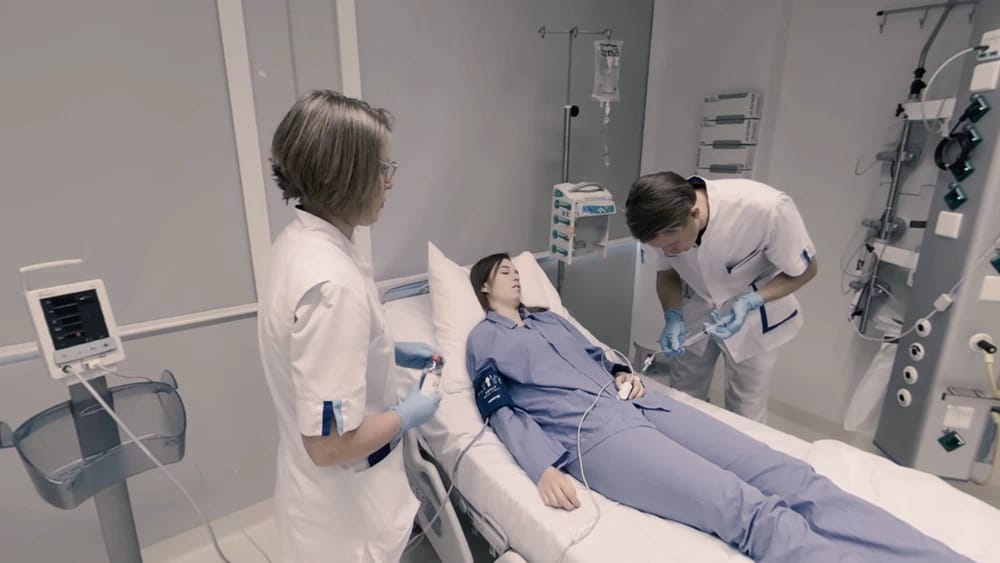
360° training video frame: two nurses attending a patient in a hospital bed

Results

The MVP was delivered in the shortest possible time – two weeks – and worked stably on the intended device.

2 wks
MVP delivered within a 3-week project
Meta Quest
with and without controllers
360°
stereo video with branching decisions
5
more projects completed for the client afterward
  • The healthcare facility was satisfied with the project and the result; their employees successfully used the VR application.
  • Onix's specialists went on to complete five more projects for the same client, involving virtual reality, mobile devices, and video content.

The challenge

A Dutch studio specializing in 360° video (under NDA) needed to demonstrate VR training capabilities to a Dutch medical institution. The hospital wanted an interactive platform for medical students and fresh healthcare professionals, where 'their decisions determine their journey.'

The MVP had to support Meta Quest with and without controllers, and ship as an internal tool for the medical institution without being published on any app store.

Initial documentation was thin: a few videos and a superficial description. We had to architect the scenario engine, evaluation system, and interaction model from a brief, on a compressed 3-week timeline.

What we built

  • Built an intuitive in-VR UI for navigation, scenario selection, and in-app tasks, usable on Meta Quest with and without controllers (eye-gaze + 2-second hold for selection)
  • Implemented 360° video playback in stereo with branching decision points, where users take part in realistic hospital scenarios and their choices unlock the next round
  • Designed the scoring and evaluation system: points based on multiple-choice answers and response time, with test results shown after the final round
  • Architected a tree-like scenario plot model with rounds (video episodes), each ending in a quiz that determines the next branch
  • Built two app versions: bundled (all scenarios + assets in the app) and server-loaded (dynamic content downloads for scalability and easier content updates)
  • Built an internal transition editor that serializes scenario branches to JSON configuration
  • Tested and locked optimal video specs for the device: stereo H.264 MP4 at 3840×3840, 30 fps with MPEG AAC audio

The project at a glance

Device
Meta Quest, with and without controllers
Video
Stereo H.264 MP4, 3840×3840 at 30 fps
Content
Bundled in the app or loaded from a server
Scenarios
Tree-structured, configured in JSON
Delivery
Internal tool, not published to app stores

How it works

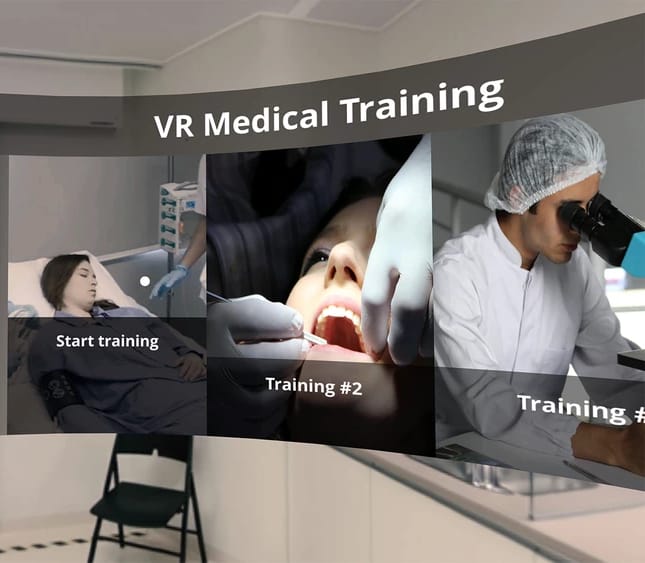
VR main menu with the Start training, Training #2 and Training #3 scenario tiles
1

Pick a training from the main menu

Users choose a training set from the main menu and are immersed in its story, played as stereo 360° video. The menu works on Meta Quest with or without controllers: holding the gaze on a tile for 2 seconds selects it.
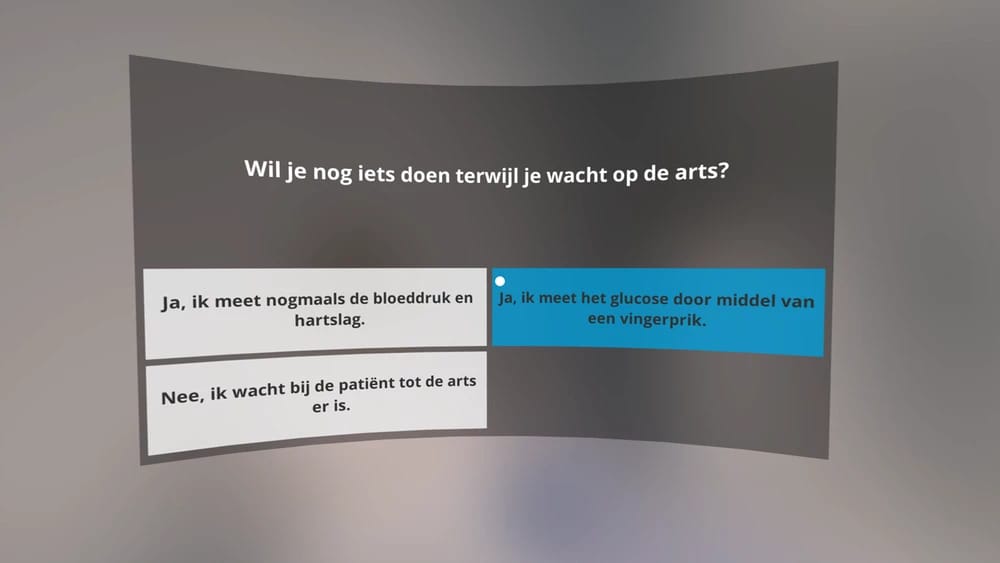
In-VR decision prompt in Dutch with three answer options
2

Decisions that change the story

At set points the app asks what the user would do next, and the answer decides the next round of the tree-structured scenario. Hints come as video or audio, and points depend on the answers and the response time.

Inside the VR Medical Training for a Dutch Hospital

Technology

  • Unity
  • C#
  • AVPro
  • CurvedUI
  • Oculus SDK
  • FFMPEG
  • LeanTween
  • JSON